sandbox/acastillo/frozen_waves/with_walls/main.c
«Frozen waves» at the interface between non-miscible fluids with strong density contrast
Preamble
Problem parameters
We consider two non-miscible fluids with densities \rho_1 and \rho_2 (\rho_1 > \rho_2) and viscosities \mu_1 and \mu_2. The interface \eta(x,y,z,t) between the two fluids is characterized by a surface tension coefficient \sigma, assumed constant. Additionally, we consider gravity g and apply a periodic oscillating motion with amplitude a and frequency \omega in the horizontal direction. For a recipient of size W\times H\times D, the system is characterised by five fluid parameters (\rho_1, \rho_2, \mu_1, \mu_2, \sigma) and three forcing parameters (a, \omega, g). If we consider the forcing displacement, the forcing frequency and the capillary length as characteristic lengths of the problem \displaystyle [\text{L}] = a, \quad [\text{T}] = \frac{1}{\omega}, \quad l_c = \sqrt{\frac{\sigma}{(\rho_1 - \rho_2) g}} we identify the following eight dimensionless groups:
| Parameter | Symbol | Definition |
|---|---|---|
| Aspect ratios | {\color{purple}\mathsf{W}} | \displaystyle \frac{W}{a} |
| {\color{purple}\mathsf{H}} | \displaystyle \frac{H}{a} | |
| {\color{purple}\mathsf{D}} | \displaystyle \frac{D}{a} | |
| Reynolds number | {\color{orange}\mathsf{Re}} | \displaystyle \frac{\rho_1 a^2\omega}{\mu_1} |
| Froude number | {\color{red}\mathsf{Fr}} | \displaystyle \frac{a\omega^2}{g} |
| Weber number | {\color{green}\mathsf{We}} | \displaystyle \frac{(\rho_1-\rho_2) a^3 \omega^2}{\sigma} |
| Atwood number | {\color{blue}\mathsf{At}} | \displaystyle \frac{\rho_1 - \rho_2}{\rho_1 + \rho_2} |
| Viscosity ratio | {\color{purple}\Upsilon} | \displaystyle \frac{\nu_2}{\nu_1} |
To complete the problem description, we specify the contact angle and the initial conditions. Here, we consider a static contact angle of \theta = 90^\circ. The interface \eta(x,y,z,t) is initially flat. We may also impose an initial perturbation in the form of a constant amplitude and random phase annular spectrum, following the approach of Dimonte et al. (2004) and Thévenin et al. (2025).
Governing equations
We use the two-phase incompressible Navier–Stokes equations. The volume fraction \phi(\mathbf{x},t) is used to transform the two-phase problem into a one-fluid formulation. If we consider the same characteristic lengths [\text{L}] and [\text{T}] as before, the equations read \begin{aligned} \nabla \cdot \mathbf{u} &= 0 \\ \partial_{t} \mathbf{u} + \nabla \cdot (\mathbf{u}\otimes\mathbf{u}) &= \frac{1}{\rho^*} \left[ -\nabla p + \nabla\cdot(2\mu^*\mathbf{D})+\sigma^*\mathbf{f}_\sigma \right] - a^* \mathbf{e}_z + \sin(t)\mathbf{e}_x \\ \partial_{t} \phi + \nabla \cdot (\phi \mathbf{u}) &= 0 \end{aligned}
where
- \mathbf{D} = (\nabla\mathbf{u}+(\nabla^*\mathbf{u})^T)/2 is the deformation tensor,
- \mathbf{f}_\sigma = \kappa \delta_s
\mathbf{n} is the surface tension force, with
- \kappa being the local interface curvature,
- \delta_s being the Dirac function associated with the interface and
- \mathbf{n} being the unit normal vector,
- \sigma^* is the (dimensionless) surface tension coefficient, \displaystyle \sigma^* = \frac{\sigma [T]^2}{\rho_0[L]^3} = 2{\color{cyan}{\color{green}\mathsf{We}}}^{-1}
- a^* is the (dimensionless) acceleration due to gravity. a^* = \frac{g[T]^2}{[L]} = {\color{blue}{\color{red}\mathsf{Fr}}}^{-1}
The equations are coupled via the (dimensionless) density and viscosity fields \begin{aligned} \rho^*(\mathbf{x},t) &= (1+{\color{blue}\mathsf{At}})\phi(\mathbf{x},t) + (1-{\color{blue}\mathsf{At}})(1-\phi(\mathbf{x},t)) \\ \mu^*(\mathbf{x},t) &= {\color{orange}\mathsf{Re}}^{-1}(1+{\color{blue}\mathsf{At}})\phi(\mathbf{x},t) + {\color{orange}\mathsf{Re}}^{-1}{\color{purple}\Upsilon}(1-{\color{blue}\mathsf{At}})(1-\phi(\mathbf{x},t)) \end{aligned}
Additionally, the computational domain is of size {\color{purple}\mathsf{W}}\times {\color{purple}\mathsf{H}}\times {\color{purple}\mathsf{D}}.
Implementation using Basilisk
Include solver blocks
We use a combination of the two-phase incompressible solver with no-slip boundaries.
// Uncomment the following lines to use different solver options
//#define FILTERED 1      // Uncomment to smudge the interface
//#define REDUCED 1       // Uncomment to use the reduced gravity approach
//#define CLSVOF 1        // Uncomment to use CLSVOF

#include "grid/multigrid.h"
#include "navier-stokes/centered.h"
// Two-phase flow configuration
#if CLSVOF
  // CLSVOF (Coupled Level Set and Volume of Fluid) method
  #include "two-phase-clsvof.h"
  #include "integral.h"
  #include "curvature.h"
#else
  // Standard VOF method
  #include "two-phase.h"
  #include "tension.h"
#endif
// Momentum conserving advection scheme
#include "navier-stokes/conserving.h"
// Reduced gravity approach (optional)
#ifdef REDUCED
  #include "reduced.h"
#endif
#include "maxruntime.h"
#include "sim_parameters.h"
Set parameters in the main loop
Parameters are now read from a JSON configuration file using the
sim_parameters.h module. The global params
struct holds all simulation parameters.
SimParams params;

#define BACKUPFREQ 100.0                // Backup frequency (in time units)
#define SNAPFREQ 100.0                  // Snapshot frequency (in time units)
#define PROFFREQ (3.14159265359)        // Profiles frequency (in time units)
#define ANIMFREQ (3.14159265359)        // Animation frequency (in time units)
#define SERIESFREQ (3.14159265359)      // Time series frequency (in time units)

#if !CLSVOF
  vector h[];
#endif

int main() {- Read parameters from JSON file (or use defaults)
read_sim_params("main.json", ¶ms);
if (pid() == 0)
print_sim_params(¶ms);- Set the domain size
  L0 = params.width;
#if dimension == 2
  dimensions (nx = params.aspectratio_x, ny = params.aspectratio_y);
  X0 = -params.width/2.;
  Y0 = -params.height/2.;
#else
  dimensions (nx = params.aspectratio_x, ny = params.aspectratio_y, nz = params.aspectratio_z);
  X0 = -params.width/2.;
  Y0 = -params.depth/2.;
  Z0 = -params.height/2.;
#endif
  N = (1 << params.level);
init_grid (N);- Assign the fluid properties
  rho1 = (1. + params.atwood);
  rho2 = (1. - params.atwood);
  mu1 = rho1 / params.reynolds;
  mu2 = rho2 * params.viscosity / params.reynolds;
#if CLSVOF
  const scalar sigma[] = 2. / params.weber;
  d.sigmaf = sigma;
#else
  f.sigma = 2. / params.weber;
  f.height = h;
#endif- Set the gravitational acceleration
#if REDUCED
  #if dimension == 2
    G.y = -1./params.froude;
  #else
    G.z = -1./params.froude;
  #endif
#endif- Set numeric parameters
  _maxruntime = params.walltime;  // Maximum runtime in seconds
  p.nodump = false; // Includes pressure in the dump file
  CFL = params.cfl;
  DT = params.dt;
  TOLERANCE = params.tolerance;
  NITERMIN = params.nitermin;
  run();
}
We add the external acceleration
To prevent sloshing, we ramp the acceleration using a sigmoid function.
\displaystyle r(t) = \frac{1}{1 + \exp(-k(t - t_\text{start}))} where t_\text{start} is the time at which the ramp starts and k is the slope of the ramp.
double sigmoid(double t1, double k){
  return 1.0 / (1.0 + exp(-k * (t - t1)));
}

double ramp;
event acceleration (i++) {
  // We set the parameters for the ramp
  double time_start = params.ramp_start;
  double time_slope = params.ramp_slope;
  ramp = sigmoid(time_start, time_slope);

  // Then, we add the acceleration
  face vector av = a;
  foreach_face(x)
    av.x[] += ramp * sin(t);

  // And finally, we add the gravity (if not using the reduced gravity approach)
  #if !REDUCED
    #if dimension == 2
      foreach_face(y)
        av.y[] -= 1./params.froude;
    #else
      foreach_face(z)
        av.z[] -= 1./params.froude;
    #endif
  #endif
}
#include "acastillo/frozen_waves/acceleration_cfl.h"
event set_dtmax (i++,last) {
  dtmax = timestep_force (u, DT, ramp);
}
Set the initial conditions
We use the initial conditions from Dimonte
(2004) as implemented in my sandbox. Note that the amplitude {\color{cyan}\mathsf{S}} we use here is a
target value, and the actual amplitude of the initial conditions is
computed in initial_condition_dimonte_fft and
initial_condition_dimonte_fft2. In practice, the r.m.s. of
the initial perturbation is
\displaystyle
{\color{cyan}\mathsf{S}}= \frac{\eta_0}{a} = \frac{1}{A} \iint
(\eta(x,y)-\overline{\eta})^2 \, dx \, dy
which is generally small.
#include "view.h"
#include "acastillo/output_fields/vtu/output_vtu.h"
#include "acastillo/output_fields/vtkhdf/output_vtkhdf.h"
void setup_snapshot(char* filename, bool video = false){
  char png_filename[256];
  char hdf_filename[256];
  if (video)
    sprintf(png_filename, "%s.mp4", filename);
  else {
    sprintf(png_filename, "%s.png", filename);
    sprintf(hdf_filename, "%s.hdf", filename);
  }

#if dimension == 2
  view( width=1024, height=1024);
  box();
  draw_vof("f", filled = -1, fc = {0,0,0} );
#else
  view( camera = "iso");
  draw_vof("f", color = "z" );
#endif
  save(png_filename);

  if (!video){
    scalar kappa[];
    #if CLSVOF
      foreach()
        kappa[] = distance_curvature (point, d);
    #else
      curvature (f, kappa);
    #endif
    output_facets_vtu(f, kappa, filename);
    output_vtkhdf({f,p}, {u}, hdf_filename);
  }
}

#if dimension == 2
  #include "acastillo/input_fields/initial_conditions_dimonte_fft1.h"
#else
  #include "acastillo/input_fields/initial_conditions_dimonte_fft2.h"
#endif

event init(i = 0){

  if (!restore(file = "./restart")){

    #if CLSVOF
      #if dimension == 2
        initial_condition_dimonte_fft(d, amplitude=params.amplitude, NX=N, kmin=params.kmin, kmax=params.kmax, isvertex=0);
      #else
        initial_condition_dimonte_fft2(d, amplitude=params.amplitude, NX=N, NY=N, kmin=params.kmin, kmax=params.kmax, isvof=1, isvertex=0);
      #endif

    #else

      vertex scalar phi[];
      #if dimension == 2
        initial_condition_dimonte_fft(phi, amplitude=params.amplitude, NX=N, kmin=params.kmin, kmax=params.kmax);
      #else
        initial_condition_dimonte_fft2(phi, amplitude=params.amplitude, NX=N, NY=N, kmin=params.kmin, kmax=params.kmax, isvof=1);
      #endif
      fractions(phi, f);

    #endif

  }
Then, we visualize the initial conditions
#if CLSVOF
  vertex scalar phi[];
  foreach_vertex()
    #if dimension == 2
      phi[] = (d[] + d[-1] + d[0,-1] + d[-1,-1])/4.;
    #else
      phi[] = (d[] + d[-1] + d[0,-1] + d[-1,-1] + d[0,0,-1] + d[-1,0,-1] + d[0,-1,-1] + d[-1,-1,-1])/8.;
    #endif
  fractions (phi, f);
#endif
  setup_snapshot("init");
}
Outputs
Convergence of the multigrid solver
A log to track the convergence of the multigrid solvers.
import numpy as np
import matplotlib.pyplot as plt

filename1 = 'out'

data = np.genfromtxt(filename1, usecols=[1,5,11], skip_header=6)
t = data[:,0]
residual_p = data[:,1]
residual_u = data[:,2]

fig, axes = plt.subplots(1,2, figsize=(4*2, 3))
ax = axes.ravel()
ax[0].semilogy(t, residual_p)
ax[1].semilogy(t, residual_u)
ax[0].set_xlabel('Time')
ax[0].set_ylabel('Residual pressure')
ax[1].set_xlabel('Time')
ax[1].set_ylabel('Residual velocity')

plt.tight_layout()
plt.savefig('plot_residuals.svg', dpi=150)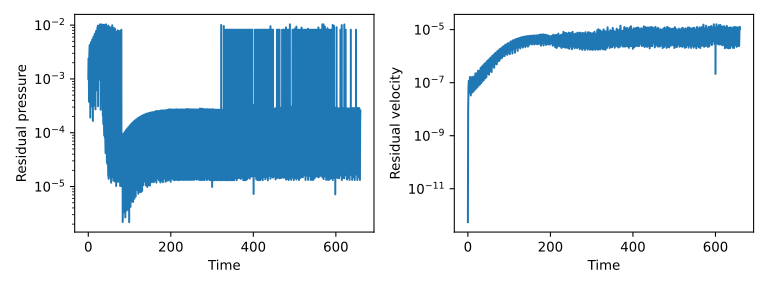
void mg_print (mgstats mg)
{
  if (mg.i > 0 && mg.resa > 0.)
    fprintf (stdout, " \t - \t %d %g %g %g %d ", mg.i, mg.resb, mg.resa,
	    mg.resb > 0 ? exp (log (mg.resb/mg.resa)/mg.i) : 0.,
	    mg.nrelax);
}

event log (i++; t <= params.endtime) {
  fprintf (stdout, " %d %g ", i, t);
  mg_print (mgp);
  mg_print (mgu);
  fprintf (stdout, "\n");
  fflush (stdout);
}

event finalize(t = end)
  dump("backup");

event backups(t += BACKUPFREQ)
  dump("backup");
Saving videos and snapshots for visualization
event animate (t += ANIMFREQ){
  setup_snapshot("animate", true);
}

event snapshot (t += SNAPFREQ){
  char name[80];
  sprintf(name, "snapshot_t%g", t);
  setup_snapshot(name);
}
1D Profiles
Let us introduce the horizontal average operator \displaystyle \overline{Q}(z,t) = \frac{1}{A} \iint_{-\infty}^{\infty} Q(\mathbf{x},t) ~dx~dy and its corresponding Reynolds decomposition as: \displaystyle Q(\mathbf{x},t) = \overline{Q}(z,t) + q(\mathbf{x},t)
We may also consider the weighted average of the horizontal profiles \displaystyle \widetilde{Q}(z,t) = \frac{\overline{\rho(\mathbf{x},t) Q(\mathbf{x},t)}}{\overline{\rho(\mathbf{x},t)}} and its corresponding Favre decomposition as: \displaystyle Q(\mathbf{x},t) = \widetilde{Q}(z,t) - q'(z,t)
We compute both kinds of vertical profiles for:
- the primitive variables, \phi, u_x, u_y, \cdots
- second order terms, \phi^2, \phi(1-\phi), \mathbf{u}^2, \phi u_z, \cdots
- dissipative terms, \nabla\mathbf{u}:\nabla\mathbf{u}, \cdots
For instance, an example of the Reynolds averaged profiles can be seen below:
import numpy as np
import matplotlib.pyplot as plt

def count_rows_until_empty(filename):
  count = 0
  with open(filename, 'r') as f:
    for line in f:
      if line.strip() == '':  # Empty line (or only whitespace)
        break
      count += 1
  return count

filename1 = 'profiles_f1.asc'
filename2 = 'profiles_K1.asc'
filename3 = 'profiles_Eps1.asc'
filename4 = 'profiles_ff1.asc'
filename5 = 'profiles_Y1.asc'
filename6 = 'profiles_F1.asc'

first_row = np.genfromtxt(filename2, max_rows=1, skip_header=1)
num_columns = len(first_row)
n = count_rows_until_empty(filename1) - 1

if num_columns == 2:
  data = np.genfromtxt(filename1, skip_header=1, usecols=[0,1,2,3,4])
  y = data[:,0].reshape(-1,n).T
  fmean = data[:,1].reshape(-1,n).T
  mmean = data[:,2].reshape(-1,n).T
  umean = data[:,3].reshape(-1,n).T
  vmean = data[:,4].reshape(-1,n).T
  L = fmean*(1-fmean)

  data = np.genfromtxt(filename2, skip_header=1, usecols=[1])
  K = data[:].reshape(-1,n).T

  data = np.genfromtxt(filename3, skip_header=1, usecols=[1])
  Eps = data[:].reshape(-1,n).T

  data = np.genfromtxt(filename4, skip_header=1, usecols=[1])
  ffmean = data[:].reshape(-1,n).T

  data = np.genfromtxt(filename5, skip_header=1, usecols=[1])
  Ymean = data[:].reshape(-1,n).T

  data = np.genfromtxt(filename6, skip_header=1, usecols=[1])
  Fmean = data[:].reshape(-1,n).T

  fig, axes = plt.subplots(3,3, figsize=(2*3, 3*3))
  ax = axes.ravel()
  nmin = 0
  nmax = 20
  nskip = 2
  ax[0].plot(fmean[:,nmin:nmax:nskip], y[:,nmin:nmax:nskip])
  ax[1].plot(umean[:,nmin:nmax:nskip], y[:,nmin:nmax:nskip])
  ax[2].plot(vmean[:,nmin:nmax:nskip], y[:,nmin:nmax:nskip])
  ax[3].plot(ffmean[:,nmin:nmax:nskip], y[:,nmin:nmax:nskip])
  ax[4].plot(K[:,nmin:nmax:nskip], y[:,nmin:nmax:nskip])
  ax[5].plot(Fmean[:,nmin:nmax:nskip], y[:,nmin:nmax:nskip])
  ax[6].plot(L[:,nmin:nmax:nskip], y[:,nmin:nmax:nskip])
  ax[7].plot(Ymean[:,nmin:nmax:nskip], y[:,nmin:nmax:nskip])
  ax[8].plot(Eps[:,nmin:nmax:nskip], y[:,nmin:nmax:nskip])

  xlabels = [r'$\overline{\phi}$', r'$\overline{u_x}$', r'$\overline{u_y}$',
  r'$\overline{\phi^2}$', r'$\overline{\mathbf{u}^2}$', r'$\overline{\phi u_y}$',
  r'$\overline{\phi}(1-\overline{\phi})$', r'$\overline{\phi(1-\phi)}$',
  r'$\overline{\nabla\mathbf{u}:\nabla\mathbf{u}}$']

  for i in range(9):
    ax[i].set_ylim([np.min(y),np.max(y)])
    ax[i].set_xlabel(xlabels[i])
    ax[i].set_ylabel(r'$y$')

plt.tight_layout()
plt.savefig('plot_profiles.svg', dpi=150)
plt.close()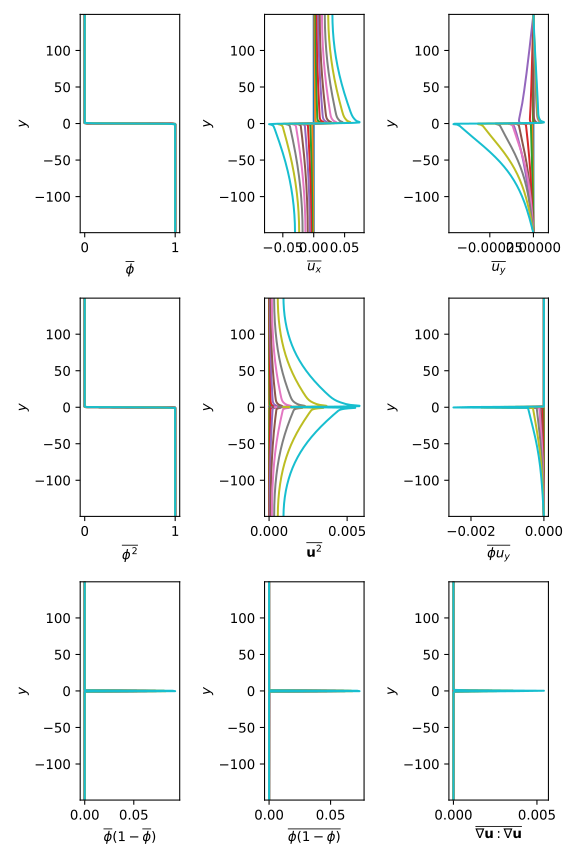
The vertical profiles may also be used to compute relevant 0D quantities, such as :
- the mixing length width \displaystyle L(t) = 6\int_{-\infty}^{\infty} \overline{\phi}(z,t)(1-\overline{\phi}(z,t))~dz
- the 0D turbulent kinetic energy and its dissipation rate \displaystyle \mathcal{K}(t) = \frac{1}{L}\int_{-\infty}^{\infty} \frac{1}{2}\overline{\mathbf{u}^2(z,t)}~dz \displaystyle \mathcal{E}(t) = \frac{1}{L}\int_{-\infty}^{\infty} \nu\overline{\nabla\mathbf{u}:\nabla\mathbf{u}}~dz
- fluctuations of the volume fraction \displaystyle \mathcal{K}_{\phi\phi}(t) = \frac{1}{L}\int_{-\infty}^{\infty} \overline{\phi(\mathbf{x},t)\phi(\mathbf{x},t)}~dz
- the vertical flux of the volume fraction \displaystyle \mathcal{F}(t) = \frac{1}{L}\int_{-\infty}^{\infty} \overline{\phi(\mathbf{x},t)u_z(\mathbf{x},t)}~dz
For instance, an example of the 0D quantities (based on the Reynolds averaged profiles) can be seen below:
import numpy as np
import matplotlib.pyplot as plt

# NumPy compatibility: trapz deprecated in 2.0, replaced by trapezoid
try:
  from numpy import trapezoid as integrate
except ImportError:
  from numpy import trapz as integrate

def count_rows_until_empty(filename):
  count = 0
  with open(filename, 'r') as f:
    for line in f:
      if line.strip() == '':  # Empty line (or only whitespace)
        break
      count += 1
  return count

filename1 = 'profiles_f1.asc'
filename2 = 'profiles_K1.asc'
filename3 = 'profiles_Eps1.asc'
filename4 = 'profiles_ff1.asc'
filename5 = 'profiles_Y1.asc'
filename6 = 'profiles_F1.asc'

first_row = np.genfromtxt(filename2, max_rows=1, skip_header=1)
num_columns = len(first_row)
n = count_rows_until_empty(filename1) - 1

profreq = np.pi

if num_columns == 2:
  data = np.genfromtxt(filename1, skip_header=1, usecols=[0,1,2,3])

  y = data[:,0].reshape(-1,n).T
  fmean = data[:,1].reshape(-1,n).T

  L = 6*integrate(fmean*(1-fmean), y, axis=0)
  t = np.arange(len(L))*profreq

  data = np.genfromtxt(filename2, skip_header=1, usecols=[1])
  UUmean = data[:].reshape(-1,n).T
  K = 0.5*integrate(UUmean, y, axis=0)/L

  data = np.genfromtxt(filename3, skip_header=1, usecols=[1])
  gradUgradUmean = data[:].reshape(-1,n).T
  Epsilon = integrate(gradUgradUmean, y, axis=0)/L

  data = np.genfromtxt(filename4, skip_header=1, usecols=[1])
  ffmean = data[:].reshape(-1,n).T
  Kcc = integrate(ffmean, y, axis=0)/L

  data = np.genfromtxt(filename5, skip_header=1, usecols=[1])
  Ymean = data[:].reshape(-1,n).T
  Theta = integrate(Ymean, y, axis=0)/integrate(fmean*(1-fmean), y, axis=0)

  data = np.genfromtxt(filename6, skip_header=1, usecols=[1])
  Fmean = data[:].reshape(-1,n).T
  F = integrate(Fmean, y, axis=0)/L

  fig, axes = plt.subplots(2,3, figsize=(4*3, 3*2))
  ax = axes.ravel()

  ax[0].plot(t, L)
  ax[1].plot(t, K)
  ax[2].plot(t, Epsilon)
  ax[3].plot(t, Kcc)
  ax[4].plot(t, Theta)
  ax[5].plot(t, F)

  ylabels = [r'$L$', r'$\mathcal{K}$', r'$\mathcal{E}$', r'$\mathcal{K}_{cc}$', r'$\Theta$', r'$\mathcal{F}$']
  for i in range(6):
    ax[i].set_xlabel(r'$t$')
    ax[i].set_xlim(np.min(t), np.max(t))
    ax[i].set_ylabel(ylabels[i])
    ax[i].ticklabel_format(style='sci', axis='y', scilimits=(0,0))

plt.tight_layout()
plt.savefig('plot_0D.svg', dpi=150)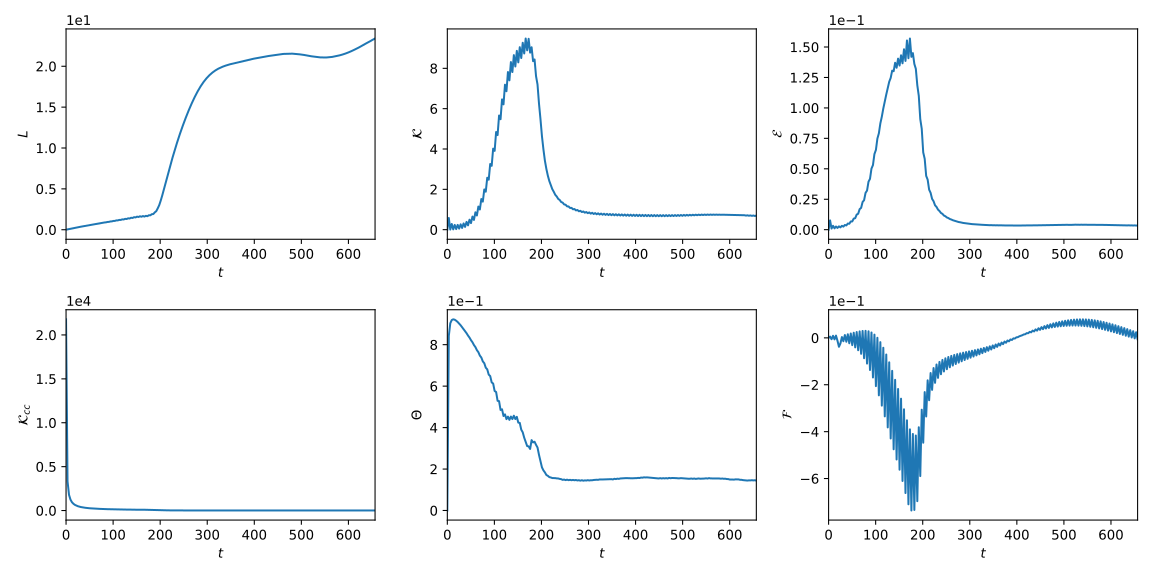
// Macro to simplify repeated profile_foreach_region calls
#include "acastillo/output_fields/profiles_foreach_region.h"
#define SAVE_PROFILE(...) \
  profile_foreach_region(__VA_ARGS__, xmin = -L0/4., xmax = L0/4., hmin = hmin, hmax = hmax)

// Function to compute the strain rate for the dissipative term
static inline double strain_rate_sq (Point point, vector u) {
  double dudx = (u.x[1]     - u.x[-1]    )/(2.*Delta);
  double dvdx = (u.y[1]     - u.y[-1]    )/(2.*Delta);
  double dudy = (u.x[0,1]   - u.x[0,-1]  )/(2.*Delta);
  double dvdy = (u.y[0,1]   - u.y[0,-1]  )/(2.*Delta);
  double Sxx = dudx;
  double Sxy = 0.5*(dudy + dvdx);
  double Syx = Sxy;
  double Syy = dvdy;
  double S2 = sq(Sxx) + sq(Sxy) + sq(Syx) + sq(Syy);
  #if dimension == 3
    double dwdx = (u.z[1]     - u.z[-1]    )/(2.*Delta);
    double dwdy = (u.z[0,1]   - u.z[0,-1]  )/(2.*Delta);
    double dudz = (u.x[0,0,1] - u.x[0,0,-1])/(2.*Delta);
    double dvdz = (u.y[0,0,1] - u.y[0,0,-1])/(2.*Delta);
    double dwdz = (u.z[0,0,1] - u.z[0,0,-1])/(2.*Delta);
    double Szz = dwdz;
    double Sxz = 0.5*(dwdx + dudz);
    double Syz = 0.5*(dwdy + dvdz);
    double Szx = Sxz;
    double Szy = Syz;
    S2 += sq(Szz) + sq(Sxz) + sq(Syz) + sq(Szx) + sq(Szy);
  #endif
  return S2;
}

event save_profiles (t += PROFFREQ){
  double del = L0 / (1 << params.level);
  double hmin = -params.height/2. + del;
  double hmax = params.height/2. - del;

    // Volume fraction, mass fraction and velocity
  scalar temp[];
  foreach(){
    temp[] = rho1*f[]/(f[]*(rho1 - rho2) + rho2);
  }

  scalar * list = {f, temp, u};
  SAVE_PROFILE(list, filename="profiles_f1.asc");
  SAVE_PROFILE(list, rhov, filename="profiles_f2.asc");

  // Kinetic energy
  foreach(){
    temp[] = 0.;
    foreach_dimension(){
      temp[] += sq(u.x[]);
    }
  }
  list = (scalar *){temp};
  SAVE_PROFILE(list, filename="profiles_K1.asc");
  SAVE_PROFILE(list, rhov, filename="profiles_K2.asc");

  // Vertical flux
  foreach(){
    #if dimension == 2
      temp[] = f[]*u.y[];
    #else
      temp[] = f[]*u.z[];
    #endif
  }
  list = (scalar *){temp};
  SAVE_PROFILE(list, filename="profiles_F1.asc");
  SAVE_PROFILE(list, rhov, filename="profiles_F2.asc");

  // Scalar dissipation
  foreach(){
    temp[] = sq(f[]);
  }
  list = (scalar *){temp};
  SAVE_PROFILE(list, filename="profiles_ff1.asc");
  SAVE_PROFILE(list, rhov, filename="profiles_ff2.asc");

  // Young parameter
  foreach(){
    temp[] = f[]*(1-f[]);
  }
  list = (scalar *){temp};
  SAVE_PROFILE(list, filename="profiles_Y1.asc");
  SAVE_PROFILE(list, rhov, filename="profiles_Y2.asc");

  // Viscous dissipation
  foreach(){
    temp[] = strain_rate_sq(point, u);
  }
  list = (scalar *){temp};
  SAVE_PROFILE(list, filename="profiles_Eps1.asc");
  SAVE_PROFILE(list, rhov, filename="profiles_Eps2.asc");
}
#undef SAVE_PROFILE
Global Quantities
import numpy as np
import matplotlib.pyplot as plt

filename1 = 'globals.asc'

first_row = np.genfromtxt(filename1, max_rows=1, skip_header=1)
num_columns = len(first_row)

if num_columns == 6:
  data = np.genfromtxt(filename1, usecols=[0,1,2,4,5])
else:
  data = np.genfromtxt(filename1, usecols=[0,1,2,5,6])

t = data[:,0]
r = data[:,1]
ekin = data[:,2]
epot = data[:,3]
epot -= epot[0]
epsilon = data[:,4]

fig, axes = plt.subplots(2, 2, figsize=(8, 6))
ax = axes.ravel()

ax[0].plot(t, r)
ax[1].plot(t, ekin)
ax[2].plot(t, epot)
ax[3].plot(t, epsilon)

ylabels = [r'$r(t)$', r'$E_{kin}(t)$', r'$E_{pot}(t)$', r'$\epsilon(t)$']
for i in range(4):
  ax[i].set_xlabel(r'$t$')
  ax[i].set_ylabel(ylabels[i])
  ax[i].set_xlim(np.min(t), np.max(t))
  ax[i].ticklabel_format(style='sci', axis='y', scilimits=(0,0))

plt.tight_layout()
plt.savefig('plot_globals.svg', dpi=150)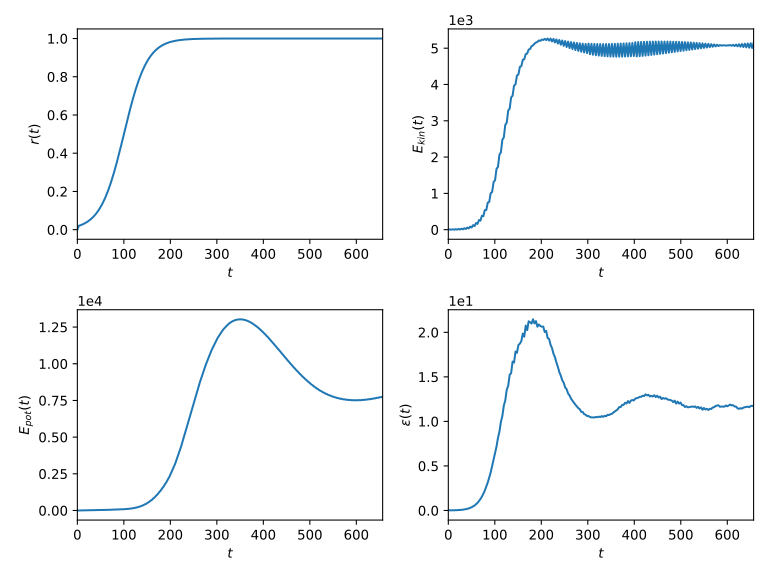
event time_series(t += SERIESFREQ){
  double ekin = 0., epot[dimension] = {0.}, epsilon = 0.;
  foreach(reduction(+:ekin) reduction(+:epot[:dimension]) reduction(+:epsilon)){
    epot[0] += dv() * rhov[] * x;
    epot[1] += dv() * rhov[] * y;
    #if dimension == 3
      epot[2] += dv() * rhov[] * z;
    #endif
    foreach_dimension()
      ekin += dv() * 0.5 * rhov[] * sq(u.x[]);
    epsilon += dv() * 2 * (mu(f[])/rhov[]) * strain_rate_sq(point, u);
  }

  if (pid()==0){
    FILE * fp = fopen("globals.asc", "a");
    fprintf (fp, "%.9g ", t);
    fprintf (fp, "%.9g ", ramp);
    fprintf (fp, "%.9g ", ekin);
    fprintf (fp, "%.9g ", epot[0]);
    fprintf (fp, "%.9g ", epot[1]);
    #if dimension == 3
      fprintf (fp, "%.9g ", epot[2]);
    #endif
    fprintf (fp, "%.9g \n", epsilon);
    fclose (fp);
  }
}
References
| [grea:2025] |
Benoit-Joseph Gréa, Andrés Castillo-Castellanos, Antoine Briard, Alexis Banvillet, Nicolas Lion, Catherine Canac, Kevin Dagrau, and Pauline Duhalde. Frozen waves in the inertial regime. Journal of Fluid Mechanics, 1021:A12, 2025. [ DOI | http | .pdf ] |
| [thevenin:2025] |
Sébastien Thévenin, Benoît-Joseph Gréa, Gilles Kluth, and Balasubramanya T. Nadiga. Leveraging initial conditions memory for modelling rayleigh–taylor turbulence. J. Fluid Mech., 2025. [ DOI ] |
| [thevenin:2024] |
Sébastien Thevenin. Contribution of machine learning to the modeling of turbulent mixing. Theses, Université Paris-Saclay, November 2024. [ http | .pdf ] |
| [dimonte:2004] |
Guy Dimonte. Dependence of turbulent rayleigh-taylor instability on initial perturbations. Phys. Rev. E, 2004. [ DOI ] |