sandbox/bugs/embed-degenerate.c
Poisson solver with degenerate embedded Dirichlet cells
For some cut cells, the third-order Dirichlet gradient of dirichlet_gradient() cannot be computed using the neighboring cells (they are not in the fluid). The gradient then depends on the value of the cell itself and embed_flux() returns a non-zero coefficient e such that the embedded flux is c + e\,a[].
This coefficient must be taken into account consistently by both the relaxation and the residual functions of the Poisson solver. This test checks this using a “star” with sharp branches, which contains degenerate cells.
The solution is trivial: with a=1 on the embedded boundary and on the domain boundaries and a zero right-hand-side, the exact solution is a=1 everywhere. The residual of the exact solution must then be zero (to round-off) and the multigrid solver must converge to it.
#include "embed.h"
#include "poisson.h"
#include "view.h"

int main()
{
  double maxres = 0., maxresa = 0.;
  for (N = 32; N <= 256; N *= 2) {
    size (1. [0]); // dimensionless
    origin (-L0/2., -L0/2.);
    init_grid (N);

    vertex scalar phi[];
    foreach_vertex() {
      double theta = atan2 (y, x), r = sqrt (sq(x) + sq(y));
      phi[] = r - (0.25 + 0.15*cos(6.*theta));
    }
    fractions (phi, cs, fs);
#if TREE
    cs.refine = cs.prolongation = fraction_refine;
#endif
    restriction ({cs, fs});

    cm = cs;
    fm = fs;

    scalar a[], b[];
    a[embed] = dirichlet (1.);
    a[left]   = dirichlet (1.);
    a[right]  = dirichlet (1.);
    a[top]    = dirichlet (1.);
    a[bottom] = dirichlet (1.);
    a.third = true;
We count the number of degenerate cells i.e. cells for which embed_flux() returns a non-zero coefficient.
    int ndeg = 0;
    scalar deg[];
    foreach (reduction(+:ndeg)) {
      double c, e = embed_flux (point, a, fs, &c);
      deg[] = e ? 1. : cs[] > 0. ? 0. : nodata;
      if (e)
        ndeg++;
    }
We compute the residual of the exact solution a=1.
    foreach()
      a[] = 1., b[] = 0.;
    scalar res[];
    struct Poisson p;
    p.a = a, p.b = b, p.alpha = fs, p.lambda = zeroc;
    p.embed_flux = embed_flux;
    maxres = max (maxres, residual ({a}, {b}, {res}, &p));
We solve the Poisson equation starting from a=0 and compute the maximum error.
    foreach()
      a[] = 0.;
    mgstats s = poisson (a, b, alpha = fs, tolerance = 1e-6);
    maxresa = max (maxresa, s.resa);
    double maxerr = 0.;
    scalar err[];
    foreach (reduction(max:maxerr)) {
      err[] = cs[] > 0. ? a[] - 1. : nodata;
      if (cs[] > 0. && fabs (a[] - 1.) > maxerr)
        maxerr = fabs (a[] - 1.);
    }

    fprintf (stderr, "%d %d %d %.2g %.2g\n",
	     N, ndeg, s.i, s.resa, maxerr);
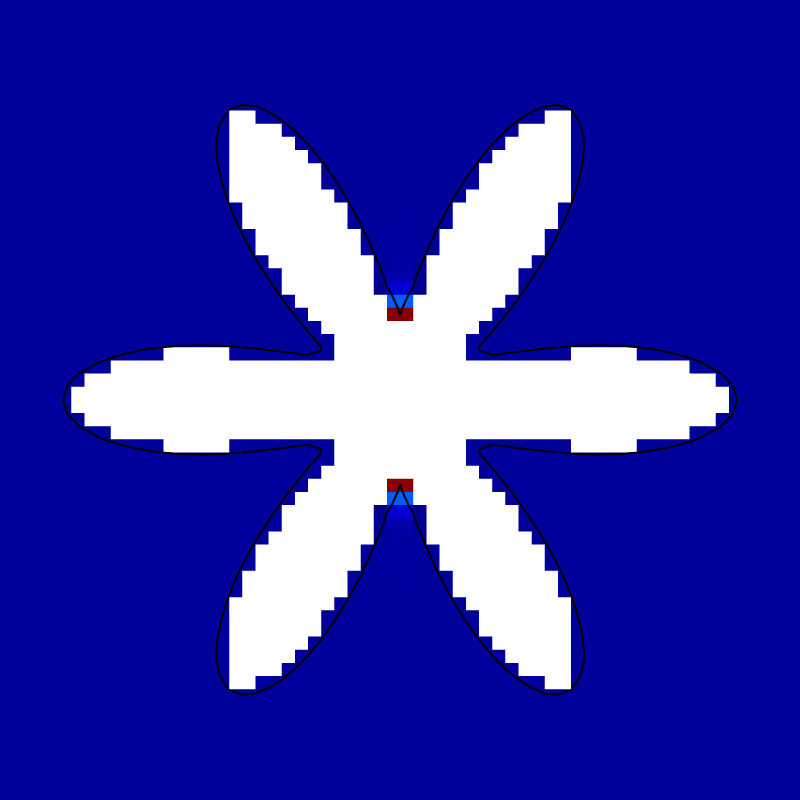
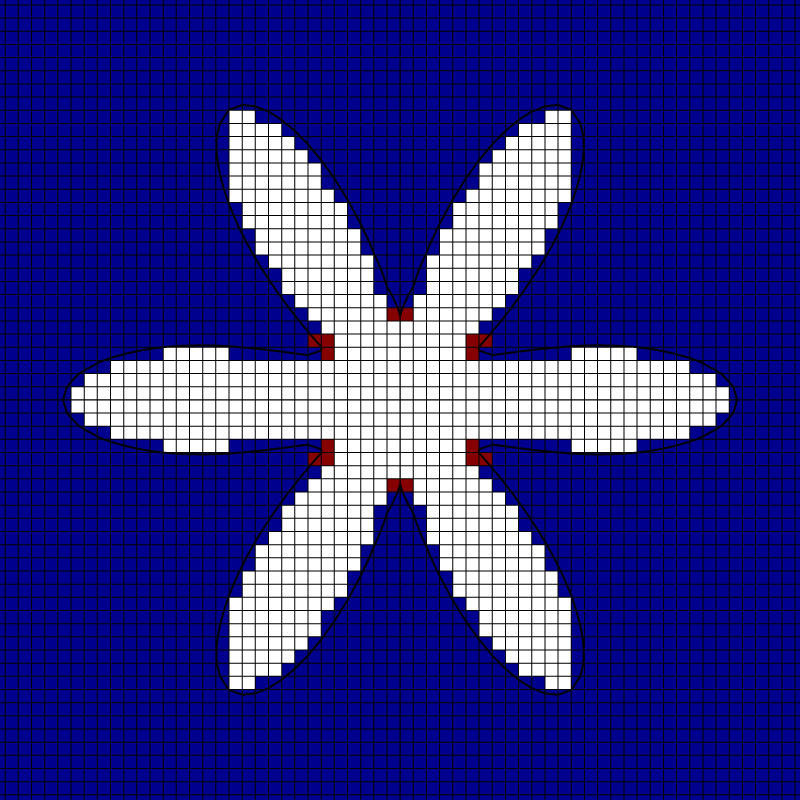
We display the degenerate cells and the error for N=64, the resolution with the largest number of degenerate cells.
    if (N == 64) {
      view (fov = 18);
      squares ("deg", spread = -1);
      draw_vof ("cs", "fs", lw = 2);
      cells();
      save ("deg.png");

      clear();
      squares ("err", spread = -1);
      draw_vof ("cs", "fs", lw = 2);
      save ("err.png");
    }
  }
For all resolutions, the residual of the exact solution must vanish (to round-off) and the solver must converge. These checks are done after the loop so that the figures are also generated when the solver diverges.
The columns are: the resolution, the number of degenerate cells, the number of multigrid cycles, the final residual and the maximum error.
If the residual is not consistent with the relaxation function (i.e. if e is not accounted for with the same sign in both), the solver diverges.
The degenerate cells are located at the tips of the narrow fluid wedges between the branches of the star, where the stencil of dirichlet_gradient() does not fit within the fluid.
With a consistent residual, the error is of the order of the tolerance of the solver. Otherwise it is concentrated in the degenerate cells and grows without bound.