sandbox/ecipriano/doc/phasechange
Gas-Liquid Phase Change Modeling
This module provides a documentation of the phase change models in Basilisk, it explains the core differences among the different models, and it provides an overview of the implementation in my sandbox. The latter contains a unified model for phase change, including variable material properties and gas phase chemical kinetics.
State-of-the-Art
Let’s first make an initial distinction. In the present documentation we consider only gas-liquid phase change model, which do not neglect the volume expansion associated with the transformation of the liquid to the gas phase. Although this term is always present, as it derives from mass conservation, it can be neglected when the density ratio or the vaporization rate are small. This approximation is convenient because it allows complications due to the interface velocity discontinuity to be avoided. However, it is usually inaccurate for boiling and droplet evaporation processes. Additionally, we consider only the models that were publicly released on the Basilisk sandbox, paying back the benefit of utilizing free software.
In the last few years, different phase change models were proposed and implented. In chronological order:
- Gennari et al., 2022: pure phase change (diffusion-driven), applied to the growth of vapor bubbles in supersaturated liquids. This work introduces the strategy of shifting the interfacial expansion term, which avoid problems with non-divergence-free interfacial cells.
- Boyd et al., 2023: pure phase change (temperature-driven), applied to boiling droplets in forced convection, with strong topological changes. This work introduces the idea of combining the phase change model with the momentum-conserving VOF scheme. Additionally, the shifting procedure from Gennari et al., 2022 is extended by smearing the expansion term over multiple cells, in order to limit oscillations arising from localized sources.
- Cipriano et al., 2023: multicomponent phase change (diffusion-driven) in non-isothermal environments, applied to multicomponent static droplet evaporation problems. This work introduces the extension of the phase change models to (multicomponent) mixtures, and it proposes a double pressure-velocity coupling procedure to obtain a liquid velocity which is perfectly divergence-free. This method is particularly beneficial for static droplets.
- Long et al., 2024: pure phase change (temperature-driven), applied to boiling problems within the Edge-Based Interface Tracking method. This is the first implementation of phase change in EBIT, and it highlights the benefit of using a Ghost Fluid Method formulation to enforce the velocity jump instead of resolving the projection step with a localized source term.
- Cipriano et al., 2024: multicomponent phase change (diffusion-driven) in non-isothermal environments with variable material properties. This work extends Cipriano et al., 2023 introducing variable properties as a function of temperature and composition changes (but with constant thermodynamic pressure). It also proposes a strategy to suspend droplets in a gravitational field, and it is applied to pure droplet evaporations in buoyancy-driven flows.
- Cipriano et al., 2025: extension of Cipriano et al., 2024 introducing chemical kinetics, applied to droplet combustion problems.
- Long et al., 2025: extension and optimization of Cipriano et al., 2023 in boiling conditions, using a Ghost Fluid Method to impose the velocity jump. This approach demonstrates the suppression of non-physical oscillations due to the localized expansion term, and it is succesfully applied to the direct solution of the microlayer during the expansion of bubbles near a solid surface, including the contact angle and conjugate heat transfer.
The implementation in this sandbox attempts to gather the main features of these models in a single, unified, framework. The main motivation behind this effort is that a single model, which is valid for every gas-liquid phase change problem, is yet to be found. However, we have different models that can be (succesfully) exploited for different simulations setups. Additionally, having a single framework allows interesting features, such as variable material properties, chemical reactions, ecc, to be easily exploited also with other people’s phase change models.
Governing equations
This model resolves the mass, momentum, chemical species mass fractions, and temperature, according to the following set of equations for the bulk liquid and gas phases (k = l, g):
\nabla\cdot\mathbf{u}_k = \textcolor{blue}{-\dfrac{1}{\rho_k}\dfrac{D\rho_k}{Dt}} = \textcolor{blue}{\beta_{T,k}\dfrac{DT_k}{Dt} + \sum_{i=1}^{NS} \beta_{\omega_{i,k}}\dfrac{D\omega_{i,k}}{Dt}}
\rho_k\dfrac{D\mathbf{u}_k}{Dt} = \nabla\cdot\left(2\mu_k\mathbf{D}_k\right) - \nabla p_k \textcolor{blue}{- \mathbf{g}\cdot\mathbf{x}\nabla\rho_k}
\rho_k\dfrac{D\omega_{i,k}}{Dt} = -\nabla\cdot\mathbf{\textcolor{blue}{j}}_{i,k} \textcolor{red}{+ \dot{\Omega}_{i,k}}
\rho_k Cp_k\dfrac{DT_k}{Dt} = \nabla\cdot\left(\lambda\nabla T_k\right) \textcolor{blue}{- \left(\sum_{i=1}^{NS}Cp_{i,k}\mathbf{j}_{i,k}\right)\cdot\nabla T_k} \textcolor{red}{- \sum_{i=1}^{NS} h_{i,k}\dot{\Omega}_{i,k} - \nabla\cdot\mathbf{q}_{rad}}
\textcolor{blue}{\phi_k = f(T_k, P_k, \omega_{i,k})}
where blue terms account for the low-Mach number variable material properties while red terms include chemical reactions and radiation. The variable \phi_k is a generic phase property (i.e. density, viscosity, diffusivity, ecc.), computed as a function of the thermodynamic state, defined by temperature, pressure, and mass fractions.
Interface jump conditions
The bulk phase equations are combined with the following gas-liquid interface jump conditions, with [\phi]_k = \phi_l - \phi_g:
[\mathbf{u}\cdot\mathbf{n}_\Gamma]_\Gamma = \textcolor{green}{\dot{m}[1/\rho]_\Gamma}
\textcolor{green}{\dot{m}^2[1/\rho]_\Gamma} + [p]_\Gamma - [2\mathbf{n}_\Gamma\cdot\mathbf{D}\cdot\mathbf{n}_\Gamma]_\Gamma = \sigma\kappa
-[2\mathbf{t}_\Gamma\cdot\mathbf{D}\cdot\mathbf{n}_\Gamma]_\Gamma = 0
[\rho(\mathbf{u} - \mathbf{u}_\Gamma)\cdot\mathbf{n}_\Gamma]_\Gamma = 0
[\rho\omega_i(\mathbf{u} - \mathbf{u}_\Gamma)\cdot\mathbf{n}_\Gamma + \mathbf{\textcolor{blue}{j}}\cdot\mathbf{n}_\Gamma]_\Gamma = 0
[\lambda\nabla T\cdot\mathbf{n}_\Gamma]_\Gamma = \textcolor{green}{\sum_{i=1}^{NS} \dot{m}_i [h_i]_\Gamma} \textcolor{red}{+ \dot{q}_{rad}}
where green terms account for the phase change. The recoil pressure term \dot{m}^2[1/\rho]_\Gamma is often neglected because it is small compared to \sigma\kappa, especially for small droplets.
The reader can refer to the papers in the State-Of-The-Art section for details about the numerical approximation of these equations.
Structure of the Code
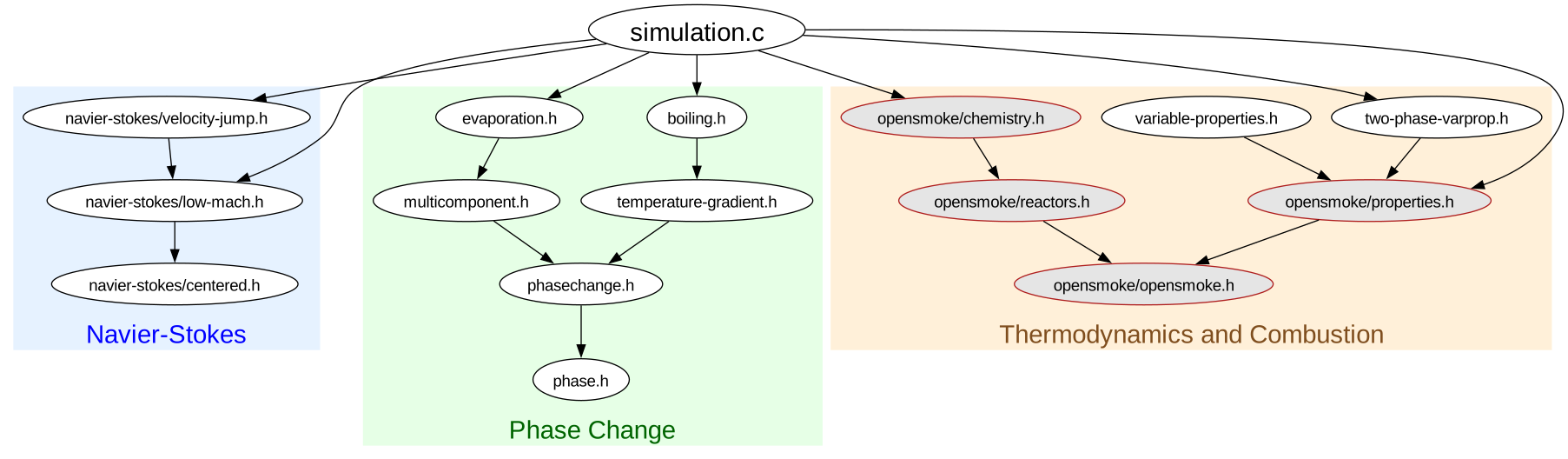
The following graph displays the connections among the main modules
of the code. The nodes which are directly connected to the
simulation.c are those that can be included in the
simulation files. The others are automatically included by the upper
layers. There are three main sections:
- Navier-StokesSolution of the Navier-Stokes equations for
nvvelocity and pressure fields, including volume expansion (or compression) terms. - Phase ChangeSolution of Advection-Diffusion-Reaction equations for multicomponent non-isothermal systems, using diffusion-driven or temperature-driven phase change models.
- Thermodynamics and CombustionCalculation of variable material properties, chemical reactions, and tools for chemistry integration.
Navier–Stokes
Phase change creates a velocity jump at the liquid–gas interface. Treating this correctly is crucial to avoid non-physical results. A standard one-field formulation may not suffice, because the liquid and gas velocities sometimes need to be resolved separately.
navier-stokes/centered-new.h: Extends the centered Navier–Stokes solver to handle
nvvelocity fields independently. The solver remains incompressible, allowing separate evolution of liquid and gas velocities. This version does not break retro-compatibility with the original centered solver.navier-stokes/low-mach.h: Adds the ability to include volumetric sources, either continuous
drhodt, or localized at the interfaceintexp. The solver itself does not determine how the flow divergence is computed; this depends on the specific scalar fields (temperature, pressure, mass fractions) and the problem setup.navier-stokes/velocity-jump.h: Implements a Ghost Fluid Method (GFM)-style approach. Instead of localized sources, it directly enforces the velocity jump at the interface in liquid and gas velocities.
Phase Change
Phase library
The central element of the phase change model is the
Phase structure, defined in phase.h. A Phase object contains all relevant
fields of a phase, including temperature, mass fractions, variable
properties, and other key information. The phase.h file declares the structure and
implements many functions to solve advection–diffusion–reaction
equations for a single multicomponent non-isothermal phase.
Using the Phase library reduces code duplication and
simplifies extensions. A typical workflow is:
// Create an instance of the phase model
Phase * phase = new_phase ("phasename", NS);

// Resolve advection as VOF tracers
phase_set_tracers (phase);
f.tracers = list_concat (f.tracers, phase->tracers);

// Resolve diffusion equations for every scalar field
phase_diffusion (phase, f);

// Update material properties
phase_update_properties (phase, &tp, f);

// Update flow divergence
phase_update_divergence (phase, &tp, f);

// Clean phase from memory
delete_phase (phase);
Basilisk macros provide iterators to loop over scalar fields and chemical species in a phase. For example, the total diffusive flux across each face can be computed using Fick’s law:
face vector j[];
foreach_scalar_in (phase)
  foreach_face()
    foreach_species_in (phase)
      j.x[] -= rho[]*D[]*face_gradient (Y, 0);
without using the macros, the same code would look like this:
face vector j[];
{
  scalar rho = phase->rho;
  foreach_face() {
    for (size_t i = 0; i < phase->n; i++) {
      scalar D = phase->DList[i];
      scalar Y = phase->YList[i];
      j.x[] -= rho[]*D[]*face_gradient (Y, 0);
    }
  }
}
The iterators automatically define local scalars for the phase lists, keeping names short, intuitive, and aligned with mathematical notation. This makes the code more readable.
Phase Change Module
The phasechange.h module creates two Phase objects
(liq and gas) and applies the phase library
functions at the appropriate events for phase change problems. Given a
list of evaporation rates per unit surface, mEvapList, it
advances the phase and VOF solutions, updates divergence and material
properties, and integrates chemistry. These operations are common to all
phase change models (evaporation, boiling, or combinations).
Interface Models
Interface models handle the interface jump conditions, specifying the evaporation rate per unit surface and gas–liquid boundary conditions for scalar fields. Three interface models are currently implemented:
fixedflux.h: Constant vaporization rate, useful for debugging or isolating expansion effects: \dot{m} = K
temperature-gradient.h: Vaporization rate from interface energy balance under boiling conditions: \dot{m} = \dfrac{\lambda_l \nabla T_l\cdot\mathbf{n}_\Gamma - \lambda_g \nabla T_g\cdot\mathbf{n}_\Gamma}{\Delta h_{ev}}
multicomponent.h: Vaporization rate from species mass balance assuming diffusion-driven evaporation: \dot{m} = \dfrac{\sum_{i=1}^{NS} \mathbf{j}_{i,g}\cdot\mathbf{n}_\Gamma}{1 - \sum_{i=1}^{NS} \omega_{i,g}}
These models cover all phase change types currently implemented in Basilisk. Combining phasechange.h with one interface model allows the simulation of evaporation or boiling.
In order to simplify setting up phase change simulations, we have two
additional modules: evaporation.h and
boiling.h which include the necessary
headers and set the phase change model parameters at the current best
configuration. These two files are the user interface. The default setup
and methods can be changed using the attributes of the pcm
structure (see Phase Change
Options).
Do you need to develop a new interface model? Just use phasechange.h with a new policy for the solution of the interface. For example, the automatic transition from evaporation to boiling can be an interesting development.
Thermodynamics and Combustion
The thermodynamic properties and combustion chemistry are handled by an external library for several reasons:
- Generality: Species and reactions are not hard-coded. Instead, they are stored in a standard CHEMKIN-format file, making it easy to change or modify the chemical mechanisms.
- Stability: Combustion chemistry often requires stiff ODE solvers for stable integration, which are already implemented in specialized libraries.
- Efficiency: Implementing these routines from scratch is unnecessary and error-prone.
In this framework, we use the OpenSMOKE++ library, with its C interface, or the Cantera library. Key components include:
- opensmoke/opensmoke.h: Functions to read CHEMKIN files, returning species names, molecular weights, and the total number of species.
- opensmoke/properties.h:
Functions for calculating material properties and connecting the
ThermoPropsfunction pointers to the appropriate routines. - opensmoke/chemistry.h: Connects the pointer stiff_ode_solver() to the stiff ODE solver in OpenSMOKE++, and implements the system of equations for the chemistry integration.
This modular structure allows other libraries to be used as long as they provide equivalent functionality for reading species, computing material properties, and integrating chemistry. As an example, see the corresponding cantera/*.h headers. Currently, Cantera provides the same functionalities of OpenSMOKE++ regarding the gas phase properties calculation and the integration of stiff systems. However, it does not include calculation of liquid phase mixture properties. As an advantage, it is already installed on the Basilisk server.
External Dependencies
Most of the code in this sandbox runs on a standard Basilisk installation. However, some models or features rely on external libraries.
GNU Scientific Library: root-finding
The evaporation model under non-isothermal conditions requires a root-finding routine to update the interfacial temperature. This functionality uses the GNU Scientific Library (GSL), which is already installed on the Basilisk server.
To enable GSL support, compile with the following flags:
CFLAGS += -DUSE_GSL=1 -I/path/to/gsl/include -L/path/to/gsl/libLibconfig: read simulation data from an input file
The simulation burningdroplet.c can be run either providing the input parameters via compilation macros or using an input file, such as burningdroplet.input. The latter method employs libconfig for parsing, and it is useful only if you want to change the input parameters at run-time.
To enable libconfig support, compile with:
CFLAGS += -DUSE_LIBCONFIG=1 -I/path/to/libconfig/include -L/path/to/libconfig/libOpenSMOKE++: variable thermodynamic, chemical kinetics, and stiff ODE solver
The variable material properties and chemical reactions rely on the C Interface for the OpenSMOKE++ library as explained in the previous section.
To enable OpenSMOKE++ support, compile with:
CFLAGS += -DUSE_OPENSMOKE=1 -I/path/to/opensmoke_c/include -L/path/to/opensmoke_c/libCantera: variable thermodynamic, chemical kinetics, and stiff ODE solver
As an alternative to OpenSMOKE++, Cantera can be used installing the
libcantera-dev following the official
instructions.
To enable Cantera support, compile with:
CFLAGS += -DUSE_CANTERA=1 -I/path/to/cantera/include -L/path/to/cantera/libSetting-up phase change simulations
This phase change model tries to mimic Basilisk’s structure as much as possible. The first thing you have to include for phase change simulations is the Navier–Stokes solver, choosing between the one-field formulation with localized source terms navier-stokes/low-mach.h, and the ghost fluid formulation navier-stokes/velocity-jump.h. Finaly, decide which phase change model you want to use (i.e., evaporation or boiling) including the proper header after the definition of the two-phase.h solver. The models are compatible with the CLSVOF solver.
Constant material properties
As a minimal example, the evaporation of two incompressible phases can be initialized as:
#include "navier-stokes/low-mach.h"
#include "two-phase.h"
#include "tension.h"
#include "evaporation.h"
Following Basilisk style, no model parameters need to be declared in the simulation file; this setup can compile and run directly. Default species and thermal properties are set using global variables:
int main() {
  ...
  rho1 = 626.7, rho2 = 17.51;
  mu1 = 1.e-3, mu2 = 1.e-5;
  Dmix1 = 0., Dmix2 = 6.77e-7;
  lambda1 = 0.1121, lambda2 = 0.04428;
  cp1 = 2505., cp2 = 1053.;
  dhev = 3.23e5;
  Pref = 2860000.;
  ...
}
For multicomponent phases, you may need to set an initial composition vector. The initial state of the phases can be imposed by setting the thermodynamic state:
event init (i = 0) {
  ...
  ThermoState tsl, tsg;
  tsl.T = 300., tsl.P = 101325., tsl.x = (double[]){1.};
  tsg.T = 800., tsl.P = 101325., tsg.x = (double[]){0.,1.};

  phase_set_thermo_state (liq, &tsl);
  phase_set_thermo_state (gas, &tsg);
  ...
}
Specific properties which are different for each species (e.g.,
diffusivity or molecular weights) can be overwritten using
phase_set_properties() within the init event. For example,
for a single liquid species and two gas species:
phase_set_properties (liq, MWs = (double[]){100.2});
phase_set_properties (gas, MWs = (double[]){100.2,29.}, Ds = (double[]){1.5e-2,2.3e-2});
Boundary Conditions
Species and temperature fields are created by the Phase
model in the default event. Therefore, boundary conditions
cannot be set globally as in classical Basilisk codes. Use the init
event to set BCs:
event init (i = 0) {
  ...
  scalar YG1 = gas->YList[0], YG2 = gas->YList[1];
  YG1[top] = dirichlet (0.);
  YG2[top] = dirichlet (1.);

  scalar TG = gas->T;
  TG[top] = dirichlet (800.);
  ...
}
This does not apply for velocity boundary conditions, which can be set in the global scope.
Default Vaporization Rate
By default, evaporation rate is zero. To activate phase change, modify parameters depending on the model.
Boiling: The mass flow rate depends on interfacial temperature gradients. By default, gas, liquid, and interface temperatures are all 300 K, so no boiling occurs. Changing these values triggers phase change:
TL0 = 354.55, TG0 = 351.45, TIntVal = TG0;Evaporation: The default thermodynamic equilibrium constant is zero K_{eq} = \hat{x}_{i,g}/\hat{x}_{i,l} = 0, meaning no evaporation. For isothermal evaporation, set this parameter as:
// Pure liquid
YIntVal = 0.5;

// Liquid mixture with 2 components
YIntVals[0] = 0.8;
YIntVals[1] = 0.4;
For temperature-dependent evaporation, use Antoine’s equation via a function pointer assigned to each liquid species:
// Declare Antoine's equation for dodecane with parameters from NIST database
double antoine_dodecane (double T, double P) {
  double A = 4.10549, B = 1625.928, C = -92.839;
  return pow (10., A - B/(T + C)) / (P*1.e-5);
}

event init (i = 0) {
  // Unpack the dodecane and set the function
  scalar Y = liq->YList[index_dodecane];
  Y.antoine = antoine_dodecane;
}
Note that Clausius-Clapeyron’s equation, which is a special case, can be adopted as well.
You can also set a global antoine() function valid for
all species, e.g., using OpenSMOKE++:
double opensmoke_antoine (double T, double P, int i) {
  ThermoState ts;
  ts.T = T, ts.P = P;
  return opensmoke_liqprop_pvap (&ts, i)/P;
}

event init (i = 0) {
  antoine = opensmoke_antoine;
}
What happends if you set all of these methods? The priority will be
given to the global antoine() function, then the attribute
of the liquid mass fraction, the vector YIntVals, and
lastly the pure equilibrium constant value YIntVal.
Variable material properties and chemical reactions
For variable material properties, include two-phase-varprop.h before the two-phase solver. This replaces the one-field property calculation with variable property fields.
A policy header can define how the variable properties are computed, or you can use variable-properties.h and implement the functions directly in the .c file. For general, multicomponent mixtures, it is more efficient to rely on a thermodynamic libraries such as OpenSMOKE++ or Cantera.
Example setup with variable properties and chemistry:
#include "navier-stokes/low-mach.h"
#include "two-phase-varprop.h"
#include "opensmoke/properties.h"
#include "opensmoke/chemistry.h"
#include "two-phase.h"
#include "tension.h"
#include "evaporation.h"
Alternatively, one can simply write functions that return a specific property and set it to the corresponding function pointer. An example is the following calculation of the gas phase density using ideal gas law.
double property_density_idealgas (void * p) {
  ThermoState * ts = (ThermoState *)p;
  double MWmix = molecular_weight();  // compute it is some way
  return ts->P*MWmix/8314.4621/ts->T;
}

event defaults (i = 0) {
  tp2.rhov = property_density_idealgas;
}
where we first define the function that computes the density, and
then we connect it to the gas phase ThermoProps structure.
The function tp2.rhov(), if not NULL, is
automatically called by the functions that update the material
properties.
To avoid this, use an external library and follow the same structure
of opensmoke/properties.h.
These libraries usually read a file in CHEMKIN
format and store information about each chemical species. This
implies that, at the beginning of variable properties simulations, you
have to call the kinetics() functions to readf the CHEMKIN
file and set the number of species:
int main () {
  ...
  kinetics ("path_to_kinetics", &NGS);
  kinetics_liquid ("path_to_kinetics", &NLS);
  ...
}
Other libraries (Cantera, FlameMaster, Reaktoro, etc.) can be interfaced following the same structure.
Phase Change Options
The phasechange.h model defines
options that modifies the behavior of every phase change model. The
default configurations can be modified by the user, changing the
variables in the pcm structure. The following table reports
an overview of the available settings.
| Option | Default | Possible Values | Description |
|---|---|---|---|
advection |
ADVECTION_VELOCITY |
NO_ADVECTION, ADVECTION_VELOCITY,
SOURCE_TERM, PLANE_SHIFTING |
Advection of the volume fraction due to the phase change:
NO_ADVECTION, we neglect this term;
ADVECTION_VELOCITY applies a phase change velocity Cipriano et al., 2023; SOURCE_TERM
employs explicit source terms; PLANE_SHIFTING adopts the
geometric plane shifting approach (Malan et al.,
2021, Gennari et al., 2022). |
shifting |
SHIFT_TO_LIQUID |
NO_SHIFTING, SHIFT_TO_LIQUID,
SHIFT_TO_GAS |
Shift the interfacial expansion term according to Gennari et al., 2022. |
diffusion |
EXPLICIT_IMPLICIT |
EXPLICIT_ONLY, EXPLICIT_IMPLICIT |
How to resolve the interface boundary conditions for the scalar
fields: EXPLICIT_ONLY employs Neumann boundary conditions;
EXPLICIT_IMPLICIT employs Robin boundary conditions. In
both cases the scalars are resolved in non-conservative form. |
boiling |
false |
true, false |
Enables optimal setup for boiling simulations. |
byrhogas |
false |
true, false |
In the advection of the volume fraction, divide the vaporization rate by the density of the gas phase instead of the liquid phase. |
expansion |
true |
true, false |
Activates interfacial expansion term due to density contrasts between phases. |
consistent |
false |
true, false |
Ensures consistent transport of scalar fields as VOF-tracers (recommended for single velocity field). |
isothermal |
false |
true, false |
Skip the solution of the temperature equation. |
isomassfrac |
false |
true, false |
Skip the solution of the species equations. |
isothermal_interface |
false |
true, false |
Set a constant interfacial temperature, to the value
TIntVal. |
fick_corrected |
false or true¹ |
true, false |
Enables Fick’s law correction for multi-component diffusion (only
available if TWO_PHASE_VARPROP is defined) (Cipriano et al., 2024). |
molar_diffusion |
false or true¹ |
true, false |
Enables molar-based diffusion formulation. |
mass_diffusion_enthalpy |
false or true¹ |
true, false |
Include enthalpy transport due to species diffusion. |
divergence |
false or true¹ |
true, false |
Updates phase divergence fields for variable-property systems. |
chemistry |
false |
true, false |
Enables chemical reaction source terms (requires chemistry module). |
normalize |
true |
true, false |
Normalizes species mass fractions after diffusion to maintain physically consistent values. |
emissivity |
0.0 |
Any real number (≥ 0) | Sets the surface emissivity for radiation models (if enabled). A null values removes the interface radiation. |
¹ The options fick_corrected,
molar_diffusion, mass_diffusion_enthalpy, and
divergence default to true only
if TWO_PHASE_VARPROP is defined; otherwise, they
default to false.
Desired features
This section reports a lists of interesting improvements of the phase change models. Feel free to add new ideas below.
- Consistent advection of species in regression.h also for plane shifting and explicit sources.
- The velocity field that transports the interface might be
independent from those in
uflist. - Compatibility with embed.h: the incompressible boiling model works with solid boundaries, see filmboiling.c. More complex cases with variable properties and diffusion corrections must be tested.
- Automatic transition from diffusion-driven to temperature-driven phase change - this is not so difficult for pure liquids, but it is really challenging for multicomponent systems.
- Avoid dependency from GSL library for root-finding
- Move the species diffusion contribution to the heat equation from multicomponent.h to phasechange.h.
References
| [long2025] |
Tian Long, Jieyun Pan, Edoardo Cipriano, Matteo Bucci, and Stéphane Zaleski. Direct numerical simulation of nucleate boiling with a resolved microlayer and conjugate heat transfer. Journal of Fluid Mechanics, 1020:A30, October 2025. [ DOI | .pdf ] |
| [cipriano2025] |
Edoardo Cipriano, Riccardo Caraccio, Alessio Frassoldati, Tiziano Faravelli, and Alberto Cuoci. Coupling Volume-Of-Fluid and Chemical Kinetics for Direct Numerical Simulations of Droplet Combustion. International Journal of Heat and Mass Transfer, 253:127586, February 2025. [ DOI | http | .pdf ] |
| [cantera] |
David G. Goodwin, Harry K. Moffat, Ingmar Schoegl, Raymond L. Speth, and Bryan W. Weber. Cantera: An object-oriented software toolkit for chemical kinetics, thermodynamics, and transport processes. https://www.cantera.org, 2025. Version 3.2.0. [ DOI ] |
| [cipriano2024] |
Edoardo Cipriano, Alessio Frassoldati, Tiziano Faravelli, Stéphane Popinet, and Alberto Cuoci. A low-Mach volume-of-fluid model for the evaporation of suspended droplets in buoyancy-driven flows. International Journal of Heat and Mass Transfer, 234:126115, December 2024. [ DOI | http | .pdf ] |
| [cipriano2023] |
Edoardo Cipriano, Abd Essamade Saufi, Alessio Frassoldati, Tiziano Faravelli, Stéphane Popinet, and Alberto Cuoci. Multicomponent Droplet Evaporation in a Geometric Volume-Of-Fluid Framework. Journal of Computational Physics, 507:112955, June 2024. [ DOI | http | .pdf ] |
| [long2024] |
Tian Long, Jieyun Pan, and Stéphane Zaleski. An edge-based interface tracking (ebit) method for multiphase flows with phase change. Journal of Computational Physics, 513:113159, 2024. [ DOI | .pdf ] |
| [boyd2023] |
Bradley Boyd and Yue Ling. A consistent volume-of-fluid approach for direct numerical simulation of the aerodynamic breakup of a vaporizing drop. Computers & Fluids, 254:105807, 2023. [ DOI | .pdf ] |
| [gennari2022] |
Gabriele Gennari, Richard Jefferson-Loveday, and Stephen J Pickering. A phase-change model for diffusion-driven mass transfer problems in incompressible two-phase flows. Chemical Engineering Science, 259:117791, 2022. [ DOI | .pdf ] |
| [cuoci2015] |
Alberto Cuoci, Alessio Frassoldati, Tiziano Faravelli, and Eliseo Ranzi. Opensmoke++: An object-oriented framework for the numerical modeling of reactive systems with detailed kinetic mechanisms. Computer Physics Communications, 192:237–264, 2015. [ DOI ] |
| [kee1996] |
Robert J Kee, Fran M Rupley, Ellen Meeks, and James A Miller. Chemkin-iii: A fortran chemical kinetics package for the analysis of gas-phase chemical and plasma kinetics. Technical report, Sandia National Lab.(SNL-CA), Livermore, CA (United States), 1996. [ DOI | .pdf ] |