sandbox/ecipriano/run/laminarflame.c
Axisymmetric H2/N2–Air Coflow Flame
This test case reproduces a laminar, axisymmetric hydrogen–air diffusion flame with detailed chemistry and transport, following the setup discussed by Toro et al. 2004.
We use the low-mach solver in order to include weak compressibility effects due to temperature and composition changes. The combustion module utilizes the phase model for the solving the advection, diffusion, and reaction step for the multicomponent gas mixture.
#include "axi.h"
#include "navier-stokes/low-mach.h"
#include "navier-stokes/perfs.h"
#if USE_OPENSMOKE
# include "opensmoke/properties.h"
# include "opensmoke/chemistry.h"
#elif USE_CANTERA
# include "cantera/properties.h"
# include "cantera/chemistry.h"
#endif
#include "combustion.h"
#include "gravity.h"
#include "spark.h"
#include "view.h"
Simulation setup
We gather data for problem, including the kinetics folder with the detailed hydrogen mechanism, the geometry of the problem, the inlet velocity, and the inlet and initial species compositon (mass fractions).
#define KINFOLDER "laminarflame.yaml"
#define FUEL_NOZZLE 9e-3
#define AIR_NOZZLE 95e-3
#define LENGTH 150e-3
#define U_AIR 0.5
#define H2_IN 0.066637
#define O2_IN 0.231442
The inlet velocity is imposed using a parabolic profile, more realistic than a flat profile for a laminar flow inside a nozzle. The central nozzle (y < R) contains the fuel, while the outward nozzle corresponds to the nitrogen/oxigen mixture.
#define parabolic 2.*U_AIR*(1. - sq(y)/sq(R))
double R = 0.5*FUEL_NOZZLE, Re = 0.5*AIR_NOZZLE;

u.n[left] = dirichlet (y <= R ? parabolic : U_AIR);
u.t[left] = dirichlet (0.);
p[left] = neumann (0.);

u.n[right] = neumann (0.);
u.t[right] = neumann (0.);
p[right] = dirichlet (0.);

u.n[top] = neumann (0.);
u.t[top] = neumann (0.);
p[top] = dirichlet (0.);
Additional useful data are the maximum (and minimum) levels of refinemt, a useful boolean for restarting long simulations, and a field which contains the heat provided by the electric spark which ignites the mixture.
int maxlevel, minlevel = 2;
bool restored = false;
scalar qspark[];

int main (int argc, char ** argv) {
We set the kinetics folders, with the gas phase kinetics and the names of the chemical species in the scheme. Those are mostly used to facilitate pre- and post-processing operations.
  kinetics (KINFOLDER, &NS);
  gas_species = new_species_names (NS);
We set the initial thermodynamic state of the two-phase system (SI units).
Pref = 101325., T0 = 300.;We change the dimensions of the domain, introduce gravity, and we decide the maximum CFL number.
  L0 = LENGTH;
  G.x = -9.81;
  CFL_MAX = 0.1;
We initialize the grid and run the simulation.
  for (maxlevel = 7; maxlevel <= 7; maxlevel++) {
    init_grid (1 << maxlevel);
    run();
  }
We de-allocate memory used for the vectors of species names.
  free_species_names (NS, gas_species), gas_species = NULL;
}

event init (i = 0) {
  if (!restore (file = "restart")) {
    foreach()
      u.x[] = U_AIR;
  }
  else
    restored = true;
We set the initial thermodynamic state of the mixture: T, P and mass
fractions. If the simulation is NOT restored, we force the
initialization of the thermo state, otherwise, it would be effective
only if the fields are constant. This is a guard to prevent problems
when refining the grid in the init event (i.e. when using
refine()).
  double x[NS];
  x[index_species ("H2")] = 0.;
  x[index_species ("O2")] = O2_IN;
  x[index_species ("N2")] = 1. - O2_IN;

  //pcm.divergence = false;

  ThermoState tsg;
  tsg.T = T0, tsg.P = Pref, tsg.x = x;

  phase_set_thermo_state (gas, &tsg, force = !restored);
The only property that we need to set, and that remains constant throughout the simulation, is the vector with the molecular weight of each species.
  double MWGs[NS];
  molecular_weights (NS, MWGs);
  phase_set_properties (gas, MWs = MWGs);
We set the spark properties: coordinate position, diameter, initial
time, total duration, value, fields to which it is applied. Consider
that the default policy is 3: heat source in the energy equation via
qspark. Phase properties are also required.
#if SPARK
  spark.T = qspark;
  spark.position = (coord){1.5e-3, 4.5e-3};
  spark.diameter = 1.5e-3;
  spark.time = 0.;
  spark.duration = 0.005;
  spark.temperature = 1e7;
  spark.phase = gas;
#endif
The boundary conditions for species and temperature are set here
because they do not exist in the global scope (i.e. where we set the
velocity bcs), and because after the init event they would
be skipped if the simulation is restored.
  scalar fuel = gas->YList[index_species ("H2")];
  scalar oxi = gas->YList[index_species ("O2")];
  scalar inert = gas->YList[index_species ("N2")];
  scalar T = gas->T;

  fuel[left] = dirichlet (y <= R ? H2_IN : 0.);
  oxi[left] = dirichlet (y <= R ? 0. : O2_IN);
  inert[left] = dirichlet (y <= R ? 1. - H2_IN : 1. - O2_IN);
  T[left] = dirichlet (T0);
}
Mesh adaptation
We adapt the grid according to the fuel mass fraction, the temperature, and the velocity field.
#if TREE
event adapt (i++) {
  scalar fuel = gas->YList[index_species ("H2")];
  adapt_wavelet ({fuel,gas->T,u.x,u.y},
      (double[]){1e-2,1e0,1e-1,1e-1}, maxlevel, minlevel);
  unrefine (x >= (0.9*L0));
}
#endif
Tracing
Check the distribution of the computational time among the different events and functions.
#if TRACE > 1
event profiling (i += 20) {
  char name[80];
  sprintf (name, "profiling-%d", maxlevel);
  static FILE * fp = fopen (name, "w");
  trace_print (fp, 1);
}
#endif
Post-processing
The following events are for post-processing.
Profiles
We extract the axial and radial profiles of temperature and mass fractions.
event profiles (t = end) {
  char name[80];
  sprintf (name, "AxialProfiles-%d", maxlevel);
  FILE * faxial = fopen (name, "w");
  fprintf (faxial, "x(1) T(2) H2(3) H2O(4) O2(5) N2(6)\n");

  {
    coord p;
    coord box[2] = {{0, 0}, {140e-3,0}};
    coord n = {100,1};
    foreach_region (p, box, n) {
      fprintf (faxial, "%g %g %g %g %g %g\n", p.x,
          interpolate (gas->T, p.x, p.y),
          interpolate (gas->YList[index_species ("H2")], p.x, p.y),
          interpolate (gas->YList[index_species ("H2O")], p.x, p.y),
          interpolate (gas->YList[index_species ("O2")], p.x, p.y),
          interpolate (gas->YList[index_species ("N2")], p.x, p.y));
    }
  }

  char name3mm[80], name10mm[80], name20mm[80], name30mm[80];
  sprintf (name3mm,  "RadialProfiles3mm-%d",  maxlevel);
  sprintf (name10mm, "RadialProfiles10mm-%d", maxlevel);
  sprintf (name20mm, "RadialProfiles20mm-%d", maxlevel);
  sprintf (name30mm, "RadialProfiles30mm-%d", maxlevel);

  FILE * fp3mm  = fopen (name3mm, "w");
  FILE * fp10mm = fopen (name10mm, "w");
  FILE * fp20mm = fopen (name20mm, "w");
  FILE * fp30mm = fopen (name30mm, "w");

  {
    coord p;
    coord box[2] = {{3e-3,0}, {3e-3,15e-3}};
    coord n = {1,100};
    foreach_region (p, box, n)
      fprintf (fp3mm, "%g %g %g %g %g\n", p.y,
          interpolate (gas->T, p.x, p.y),
          interpolate (gas->XList[index_species ("H2")], p.x, p.y),
          interpolate (gas->XList[index_species ("O2")], p.x, p.y),
          interpolate (gas->XList[index_species ("H2O")], p.x, p.y));
  }

  {
    coord p;
    coord box[2] = {{10e-3,0}, {10e-3,15e-3}};
    coord n = {1,100};
    foreach_region (p, box, n)
      fprintf (fp10mm, "%g %g %g %g %g\n", p.y,
          interpolate (gas->T, p.x, p.y),
          interpolate (gas->XList[index_species ("H2")], p.x, p.y),
          interpolate (gas->XList[index_species ("O2")], p.x, p.y),
          interpolate (gas->XList[index_species ("H2O")], p.x, p.y));
  }

  {
    coord p;
    coord box[2] = {{20e-3,0}, {20e-3,15e-3}};
    coord n = {1,100};
    foreach_region (p, box, n)
      fprintf (fp20mm, "%g %g %g %g %g\n", p.y,
          interpolate (gas->T, p.x, p.y),
          interpolate (gas->XList[index_species ("H2")], p.x, p.y),
          interpolate (gas->XList[index_species ("O2")], p.x, p.y),
          interpolate (gas->XList[index_species ("H2O")], p.x, p.y));
  }

  {
    coord p;
    coord box[2] = {{30e-3,0}, {30e-3,15e-3}};
    coord n = {1,100};
    foreach_region (p, box, n)
      fprintf (fp30mm, "%g %g %g %g %g\n", p.y,
          interpolate (gas->T, p.x, p.y),
          interpolate (gas->XList[index_species ("H2")], p.x, p.y),
          interpolate (gas->XList[index_species ("O2")], p.x, p.y),
          interpolate (gas->XList[index_species ("H2O")], p.x, p.y));
  }

  fclose (faxial);
  fclose (fp3mm);
  fclose (fp10mm);
  fclose (fp20mm);
  fclose (fp30mm);

  scalar fuel = gas->YList[index_species ("H2")];
  scalar oxi = gas->YList[index_species ("O2")];
  scalar h2o = gas->YList[index_species ("H2O")];
  scalar T = gas->T;

  char name2[80];
  sprintf (name2, "Maps-%d", maxlevel);
  FILE * fpm = fopen (name2, "w");

  output_field ({fuel,oxi,h2o,T,u.x,u.y}, fp = fpm, linear = true,
      box = {{0,0}, {0.85*LENGTH,50e-3}});
}
Movie
Evolution of the temperature and the mass fractions of O2 and H2O in time.
event movie (t += 0.01) {
  clear();
  view (tx = -0.5);
  squares ("T", min = 300., max = 1960.);
  mirror ({0,-1}) {
    cells();
  }
  save ("temperature.mp4");

  clear();
  view (tx = -0.5);
  squares ("YO2", min = 0., max = 0.232);
  mirror ({0,-1}) {
    squares ("YH2O", min = 0., max = 0.173);
  }
  save ("species.mp4");
}

event end (t = 0.3);
Results
We plot maps, radial, and axial profiles for species and temperatures. The comparison with experimental data shows displacements which can be due to: (i) low level of refinement; (ii) no radiation if using Cantera; (iii) neglected Soret effect.
LEVEL = 7

set size ratio -1
unset key
unset xtics
unset ytics
unset colorbox
set pm3d
set pm3d map interpolate 3,3
set palette defined ( 0 0 0 0.5647, 0.125 0 0.05882 1, 0.25 0 0.5647 1, \
                          0.375 0.05882 1 0.9333, 0.5 0.5647 1 0.4392, \
                      0.625 1 0.9333 0, 0.75 1 0.4392 0, \
                      0.875 0.9333 0 0, 1 0.498 0 0 )

set xlabel "x"
set ylabel "y"
set title "temperature [K]"
set colorbox

splot "Maps-".LEVEL u 1:2:6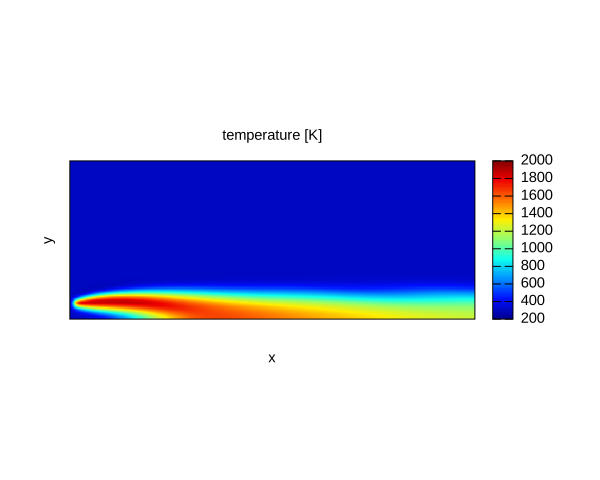
set title "mass fraction H2 [-]"
splot "Maps-".LEVEL u 1:2:3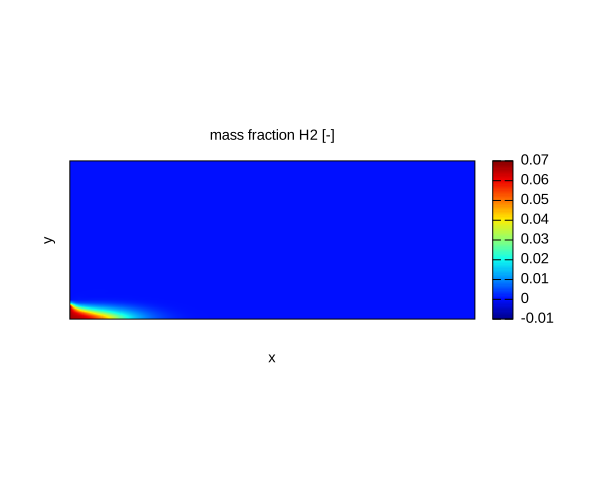
set title "mass fraction O2 [-]"
splot "Maps-".LEVEL u 1:2:4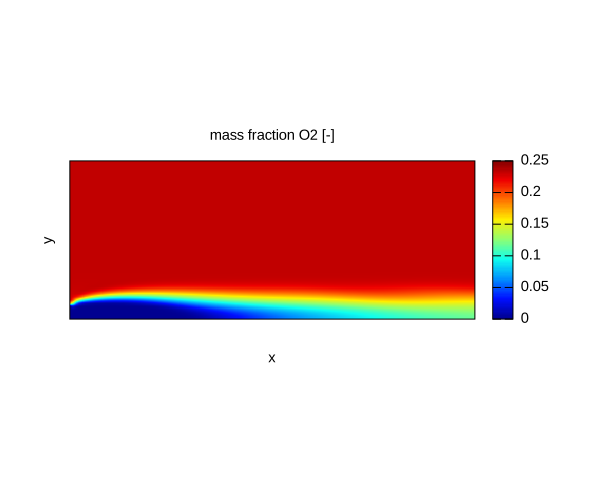
set title "mass fraction H2O [-]"
splot "Maps-".LEVEL u 1:2:5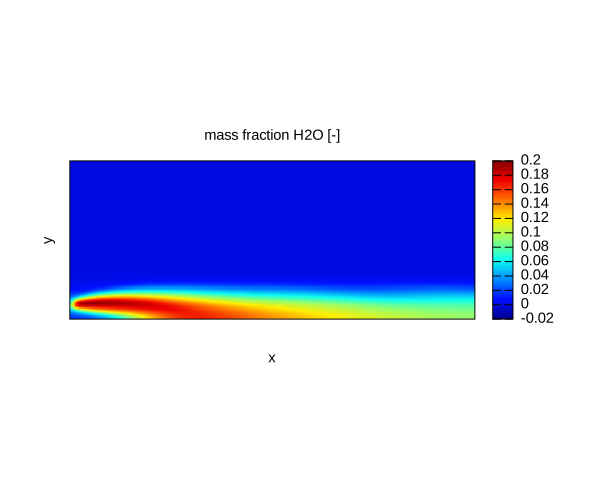
set title "u.x [m/s]"
splot "Maps-".LEVEL u 1:2:7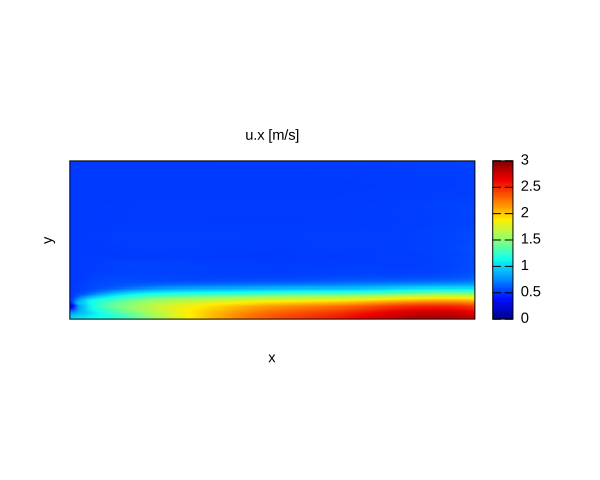
reset
set grid
set xlabel "axial distance [mm]"
set ylabel "temperature [K]"

plot "AxialProfiles-".LEVEL u ($1*1e3):2 w l dt 1 lc -1 t "Temperature", \
     "../data/toro2004/50cms/axis-T.exp" u 1:2 w p lc -1 t "Toro et al., 2004 - CARS", \
     "../data/toro2004/50cms/axis-T.exp" u 3:4 w p lc -1 t "Toro et al., 2004 - Raman"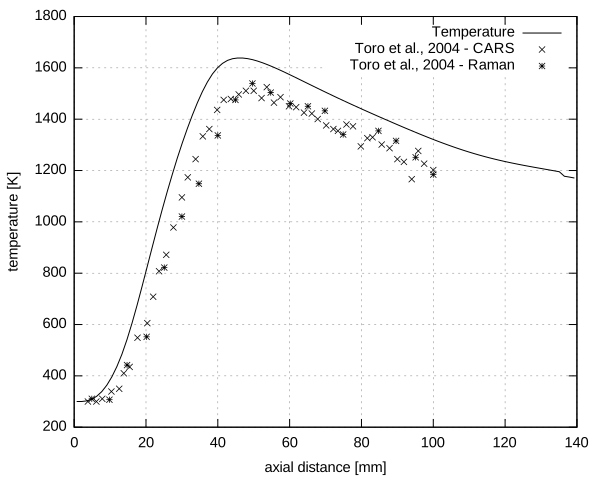
set grid
set xlabel "radial distance [mm]"
set ylabel "temperature [K]"
set xr[-15:15]
set yr[200:2200]

set y2tics
set y2r[0:1]
set y2label "mass fractions [-]"

plot "RadialProfiles3mm-".LEVEL u ($1*1e3):2 w l dt 1 lc -1 t "Temperature", \
     "RadialProfiles3mm-".LEVEL u (-$1*1e3):2 w l dt 1 lc -1 notitle, \
     "RadialProfiles3mm-".LEVEL u ($1*1e3):3 w l dt 1 lc 1 t "H2" axis x1y2, \
     "RadialProfiles3mm-".LEVEL u (-$1*1e3):3 w l dt 1 lc 1 notitle axis x1y2, \
     "RadialProfiles3mm-".LEVEL u ($1*1e3):4 w l dt 1 lc 2 t "O2" axis x1y2, \
     "RadialProfiles3mm-".LEVEL u (-$1*1e3):4 w l dt 1 lc 2 notitle axis x1y2, \
     "RadialProfiles3mm-".LEVEL u ($1*1e3):5 w l dt 1 lc 3 t "H2O" axis x1y2, \
     "RadialProfiles3mm-".LEVEL u (-$1*1e3):5 w l dt 1 lc 3 notitle axis x1y2, \
     "../data/toro2004/50cms/radial-3mm-T.exp" u 1:2 w p lc -1 t "Toro et al., 2004", \
     "../data/toro2004/50cms/radial-3mm-H2.exp" w p lc 1 axis x1y2 notitle, \
     "../data/toro2004/50cms/radial-3mm-O2.exp" w p lc 2 axis x1y2 notitle, \
     "../data/toro2004/50cms/radial-3mm-H2O.exp" w p lc 3 axis x1y2 notitle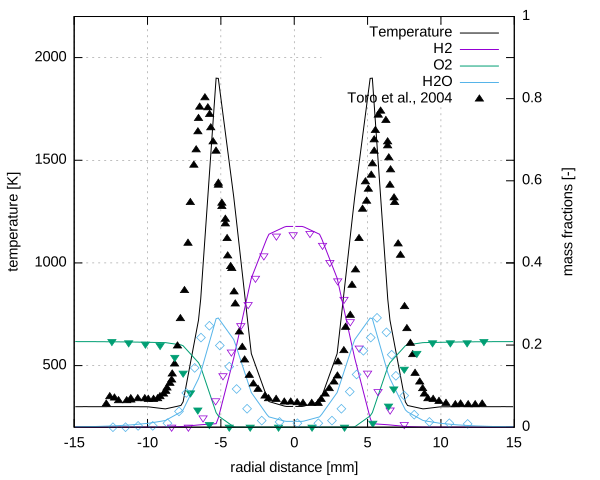
set grid
set xlabel "radial distance [mm]"
set ylabel "temperature [K]"

set y2tics
set y2r[0:1]
set y2label "mass fractions [-]"

plot "RadialProfiles10mm-".LEVEL u ($1*1e3):2 w l dt 1 lc -1 t "Temperature", \
     "RadialProfiles10mm-".LEVEL u (-$1*1e3):2 w l dt 1 lc -1 notitle, \
     "RadialProfiles10mm-".LEVEL u ($1*1e3):3 w l dt 1 lc 1 t "H2" axis x1y2, \
     "RadialProfiles10mm-".LEVEL u (-$1*1e3):3 w l dt 1 lc 1 notitle axis x1y2, \
     "RadialProfiles10mm-".LEVEL u ($1*1e3):4 w l dt 1 lc 2 t "O2" axis x1y2, \
     "RadialProfiles10mm-".LEVEL u (-$1*1e3):4 w l dt 1 lc 2 notitle axis x1y2, \
     "RadialProfiles10mm-".LEVEL u ($1*1e3):5 w l dt 1 lc 3 t "H2O" axis x1y2, \
     "RadialProfiles10mm-".LEVEL u (-$1*1e3):5 w l dt 1 lc 3 notitle axis x1y2, \
     "../data/toro2004/50cms/radial-10mm-T.exp" u 1:2 w p lc -1 t "Toro et al., 2004 - CARS", \
     "../data/toro2004/50cms/radial-10mm-T.exp" u 3:4 w p lc -1 t "Toro et al., 2004 - Raman", \
     "../data/toro2004/50cms/radial-10mm-H2.exp" w p lc 1 axis x1y2 notitle, \
     "../data/toro2004/50cms/radial-10mm-O2.exp" w p lc 2 axis x1y2 notitle, \
     "../data/toro2004/50cms/radial-10mm-H2O.exp" w p lc 3 axis x1y2 notitle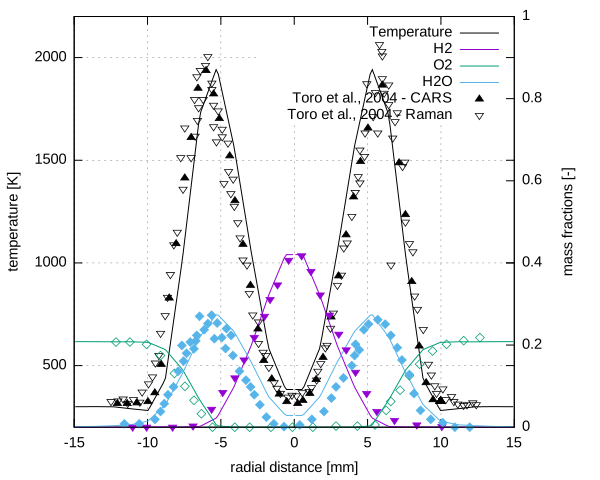
set grid
set xlabel "radial distance [mm]"
set ylabel "temperature [K]"

set y2tics
set y2r[0:1]
set y2label "mass fractions [-]"

plot "RadialProfiles20mm-".LEVEL u ($1*1e3):2 w l dt 1 lc -1 t "Temperature", \
     "RadialProfiles20mm-".LEVEL u (-$1*1e3):2 w l dt 1 lc -1 notitle, \
     "RadialProfiles20mm-".LEVEL u ($1*1e3):3 w l dt 1 lc 1 t "H2" axis x1y2, \
     "RadialProfiles20mm-".LEVEL u (-$1*1e3):3 w l dt 1 lc 1 notitle axis x1y2, \
     "RadialProfiles20mm-".LEVEL u ($1*1e3):4 w l dt 1 lc 2 t "O2" axis x1y2, \
     "RadialProfiles20mm-".LEVEL u (-$1*1e3):4 w l dt 1 lc 2 notitle axis x1y2, \
     "RadialProfiles20mm-".LEVEL u ($1*1e3):5 w l dt 1 lc 3 t "H2O" axis x1y2, \
     "RadialProfiles20mm-".LEVEL u (-$1*1e3):5 w l dt 1 lc 3 notitle axis x1y2, \
     "../data/toro2004/50cms/radial-20mm-T.exp" u 1:2 w p lc -1 t "Toro et al., 2004 - CARS", \
     "../data/toro2004/50cms/radial-20mm-T.exp" u 3:4 w p lc -1 t "Toro et al., 2004 - Raman", \
     "../data/toro2004/50cms/radial-20mm-H2.exp" w p lc 1 axis x1y2 notitle, \
     "../data/toro2004/50cms/radial-20mm-O2.exp" w p lc 2 axis x1y2 notitle, \
     "../data/toro2004/50cms/radial-20mm-H2O.exp" w p lc 3 axis x1y2 notitle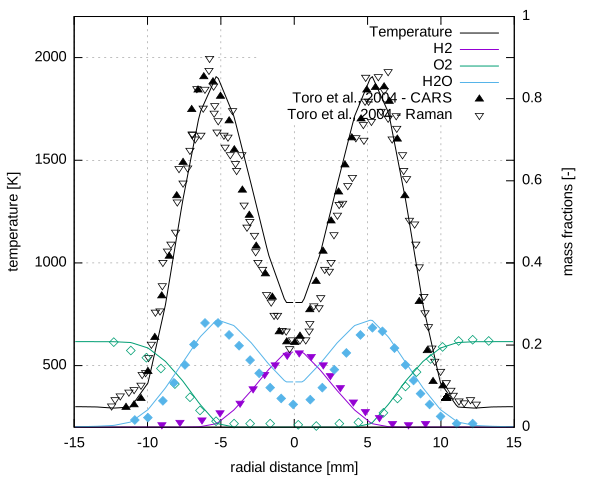
set grid
set xlabel "radial distance [mm]"
set ylabel "temperature [K]"

set y2tics
set y2r[0:1]
set y2label "mass fractions [-]"

plot "RadialProfiles30mm-".LEVEL u ($1*1e3):2 w l dt 1 lc -1 t "Temperature", \
     "RadialProfiles30mm-".LEVEL u (-$1*1e3):2 w l dt 1 lc -1 notitle, \
     "RadialProfiles30mm-".LEVEL u ($1*1e3):3 w l dt 1 lc 1 t "H2" axis x1y2, \
     "RadialProfiles30mm-".LEVEL u (-$1*1e3):3 w l dt 1 lc 1 notitle axis x1y2, \
     "RadialProfiles30mm-".LEVEL u ($1*1e3):4 w l dt 1 lc 2 t "O2" axis x1y2, \
     "RadialProfiles30mm-".LEVEL u (-$1*1e3):4 w l dt 1 lc 2 notitle axis x1y2, \
     "RadialProfiles30mm-".LEVEL u ($1*1e3):5 w l dt 1 lc 3 t "H2O" axis x1y2, \
     "RadialProfiles30mm-".LEVEL u (-$1*1e3):5 w l dt 1 lc 3 notitle axis x1y2, \
     "../data/toro2004/50cms/radial-30mm-T.exp" u 1:2 w p lc -1 t "Toro et al., 2004 - CARS", \
     "../data/toro2004/50cms/radial-30mm-T.exp" u 3:4 w p lc -1 t "Toro et al., 2004 - Raman", \
     "../data/toro2004/50cms/radial-30mm-H2.exp" w p lc 1 axis x1y2 notitle, \
     "../data/toro2004/50cms/radial-30mm-O2.exp" w p lc 2 axis x1y2 notitle, \
     "../data/toro2004/50cms/radial-30mm-H2O.exp" w p lc 3 axis x1y2 notitle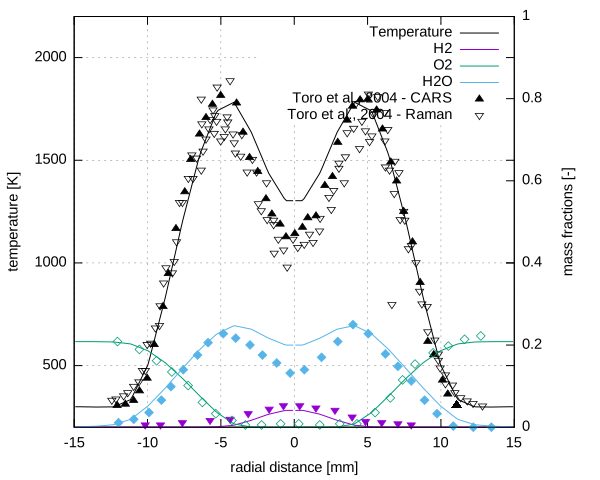
References
| [toro2005combined] |
VV Toro, AV Mokhov, HB Levinsky, and MD Smooke. Combined experimental and computational study of laminar, axisymmetric hydrogen–air diffusion flames. Proceedings of the Combustion Institute, 30(1):485–492, 2005. |